 Add to Chrome
 Add to Firefox
 Add to Edge
5G PRS
Papers and Code
Quality-Aware Denoising of Ultra-Short TDoA Measurements for 5G-NR UAV Localization
Apr 09, 2026
Reliable positioning is essential for Uncrewed Aerial Vehicles (UAVs) in safety-critical urban operations, yet achieving sub-meter accuracy under stringent latency constraints remains challenging. While 3rd Generation Partnership Project (3GPP) specifies repeated Positioning Reference Signals (PRS) transmissions for accurate Time Difference of Arrival (TDoA) measurements, denoising techniques specifically tailored for extremely limited measurement sequences within 3GPP frameworks remain underexplored. We propose Adaptive Gain Exponential Smoother (AGES), a lightweight filter combining exponentially weighted averaging with adaptive gains informed by 3GPP measurement quality reports. Simulations demonstrate AGES achieves 30-40% reduction in positioning error with only 3-5 repeated measurements while maintaining Fifth Generation New Radio (5G-NR) infrastructure compatibility.

Evaluation of gNB Monostatic Sensing for UAV Use Case
Apr 02, 20263GPP Release 19 has initiated the standardization of integrated sensing and communications (ISAC), including a channel model for monostatic sensing, evaluation scenarios, and performance assessment methodologies. These common assumptions provide an important basis for ISAC evaluation, but reproducible end-to-end studies still require a transparent sensing implementation. This paper evaluates 5G New Radio (NR) base station (gNB)-based monostatic sensing for the Unmanned Aerial Vehicle (UAV) use case using a 5G NR downlink Cyclic Prefix-Orthogonal Frequency Division Multiplexing (CP-OFDM) waveform and positioning reference signals (PRS), following 3GPP Urban Macro-Aerial Vehicle (UMa-AV) scenario assumptions. We present an end-to-end processing chain for multi-target detection and 3D localization, achieving more than 70% detection probability with less than 5% false alarm rate, in the considered scenario. For correctly detected targets, localization errors are on the order of a few meters, with a 90th-percentile error of 4m and 6m in the vertical and horizontal directions, respectively. To support reproducible baseline studies and further research, we release the simulator 5GNRad, which reproduces our evaluation
Integrated sensing and communications in the 3GPP New Radio: sensing limits
Mar 30, 2026Integrated Sensing and Communications (ISAC) is regarded as a key element of the beyond-fifth-generation (5G) and sixth-generation (6G) systems, raising the question of whether current 5G New Radio (NR) signal structures can meet the sensing accuracy requirements specified by the Third Generation Partnership Project (3GPP). This paper addresses this issue by analyzing the fundamental limits of range and velocity estimation through the Cramér-Rao lower bound (CRLB) for a monostatic unmanned aerial vehicle (UAV) sensing use case currently under consideration in the 3GPP standardization process. The study focuses on standardized signals and also evaluates the potential performance gains achievable with reference signals specifically designed for sensing purposes. The compact CRLB expressions derived in this work highlight the fundamental trade-offs between estimation accuracy and system parameters. The results further indicate that information from multiple slots must be exploited in the estimation process to attain the performance targets defined by the 3GPP. As a result, the 5G NR positioning reference signal (PRS), whose patterns may be suboptimal for velocity estimation when using single-slot resources, becomes suitable when multislot estimation is employed. Finally, we propose a two-step iterative range and radial-velocity estimator that attains the CRLB over a significantly wider range of distances than conventional maximum-likelihood (ML) estimators, for which the well-known threshold effect severely limits the distance range over which the accuracy requirements imposed by the 3GPP are satisfied.
LEO-based Carrier-Phase Positioning for 6G: Design Insights and Comparison with GNSS
Mar 18, 2026The integration of non-terrestrial networks (NTN) into 5G new radio (NR) enables a new class of positioning capabilities based on cellular signals transmitted by Low-Earth Orbit (LEO) satellites. In this paper, we investigate joint delay-and-carrier-phase positioning for LEO-based NR-NTN systems and provide a convergence-centric comparison with Global Navigation Satellite Systems (GNSS). We show that the rapid orbital motion of LEO satellites induces strong temporal and geometric diversity across observation epochs, thereby improving the conditioning of multi-epoch carrier-phase models and enabling significantly faster integer-ambiguity convergence. To enable robust carrier-phase tracking under intermittent positioning reference signal (PRS) transmissions, we propose a dual-waveform design that combines wideband PRS for delay estimation with a continuous narrowband carrier for phase tracking. Using a realistic simulation framework incorporating LEO orbit dynamics, we demonstrate that LEO-based joint delay-and-carrier-phase positioning achieves cm-level accuracy with convergence times on the order of a few seconds, whereas GNSS remains limited to meter-level accuracy over comparable short observation windows. These results establish LEO-based cellular positioning as a strong complement and potential alternative to GNSS for high-accuracy positioning, navigation, and timing (PNT) services in future wireless networks.
Design of Orthogonal Phase of Arrival Positioning Scheme Based on 5G PRS and Optimization of TOA Performance
Oct 30, 2025This study analyzes the performance of positioning techniques based on configuration changes of 5G New Radio signals. In 5G networks, a terminal position is determined from the Time of Arrival of Positioning Reference Signals transmitted by base stations. We propose an algorithm that improves TOA accuracy under low sampling rate constraints and implement 5G PRS for positioning in a software defined modem. We also examine how flexible time frequency resource allocation of PRS affects TOA estimation accuracy and discuss optimal PRS configurations for a given signal environment.
MULTI-SCOUT: Multistatic Integrated Sensing and Communications in 5G and Beyond for Moving Target Detection, Positioning, and Tracking
Jul 03, 2025This paper presents a complete signal-processing chain for multistatic integrated sensing and communications (ISAC) using 5G Positioning Reference Signal (PRS). We consider a distributed architecture in which one gNB transmits a periodic OFDM-PRS waveform while multiple spatially separated receivers exploit the same signal for target detection, parameter estimation and tracking. A coherent cross-ambiguity function (CAF) is evaluated to form a range-Doppler map from which the bistatic delay and radial velocity are extracted for every target. For a single target, the resulting bistatic delays are fused through nonlinear least-squares trilateration, yielding a geometric position estimate, and a regularized linear inversion of the radial-speed equations yields a two-dimensional velocity vector, where speed and heading are obtained. The approach is applied to 2D and 3D settings, extended to account for time synchronization bias, and generalized to multiple targets by resolving target association. The sequence of position-velocity estimates is then fed to standard and extended Kalman filters to obtain smoothed tracks. Our results show high-fidelity moving-target detection, positioning, and tracking using 5G PRS signals for multistatic ISAC.
Detecting Airborne Objects with 5G NR Radars
May 30, 2025The integration of sensing capabilities into 5G New Radio (5G NR) networks offers an opportunity to enable the detection of airborne objects without the need for dedicated radars. This paper investigates the feasibility of using standardized Positioning Reference Signals (PRS) to detect UAVs in Urban Micro (UMi) and Urban Macro (UMa) propagation environments. A full 5G NR radar processing chain is implemented, including clutter suppression, angle and range estimation, and 3D position reconstruction. Simulation results show that performance strongly depends on the propagation environment. 5G NR radars exhibit the highest missed detection rate, up to 16%, in UMi, due to severe clutter. Positioning error increases with target distance, resulting in larger errors in UMa scenarios and at higher UAV altitudes. In particular, the system achieves a position error within 4m in the UMi environment and within 8m in UMa. The simulation platform has been released as open-source software to support reproducible research in integrated sensing and communication (ISAC) systems.
Localization Accuracy Improvement in Multistatic ISAC with LoS/NLoS Condition using 5G NR Signals
Dec 23, 2024


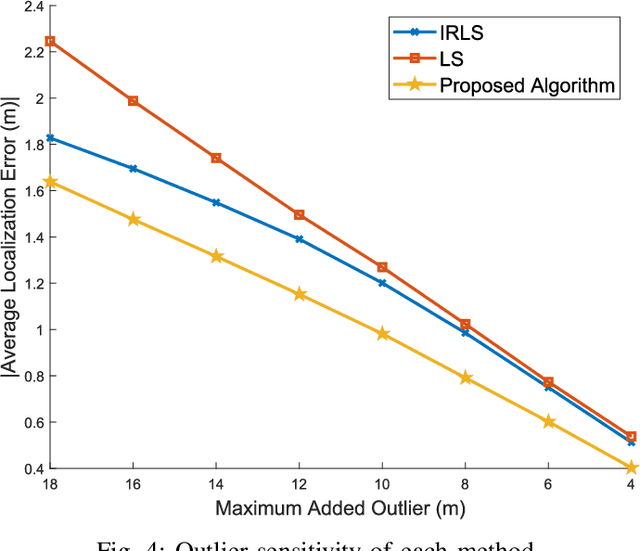
Integrated sensing and communication (ISAC) is anticipated to play a crucial role in sixth-generation (6G) mobile communication networks. A significant challenge in ISAC systems is the degradation of localization accuracy due to poor propagation conditions, such as multipath effects and non-line-of-sight (NLoS) scenarios. These conditions result in outlier measurements that can severely impact localization performance. This paper investigates the enhancement of target localization accuracy in multistatic ISAC systems under both line-of-sight (LoS) and NLoS conditions. We leverage positioning reference signal (PRS), which is currently employed in fifth-generation (5G) new radio (NR) for user equipment (UE) positioning, as the sensing signal. We introduce a novel algorithm to improve localization accuracy by mitigating the impact of outliers in range measurements, while also accounting for errors due to PRS range resolution. Eventually, through simulation results, we demonstrate the superiority of the proposed method over previous approaches. Indeed, we achieve up to 28% and 20% improvements in average localization error over least squares (LS) and iteratively reweighted least squares (IRLS) methods, respectively. Additionally, we observe up to 16% and 13% enhancements in the 90th percentile of localization error compared to LS and IRLS, respectively. Our simulation is based on 3rd Generation Partnership Project (3GPP) standards, ensuring the applicability of our results across diverse environments, including urban and indoor areas.
Empowering 5G PRS-Based ISAC with Compressed Sensing
Jul 18, 2024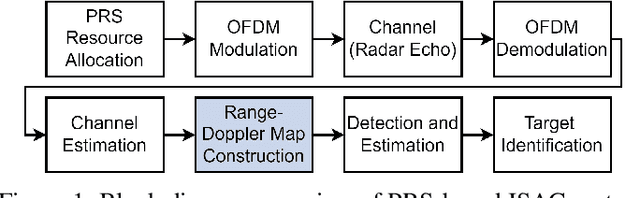
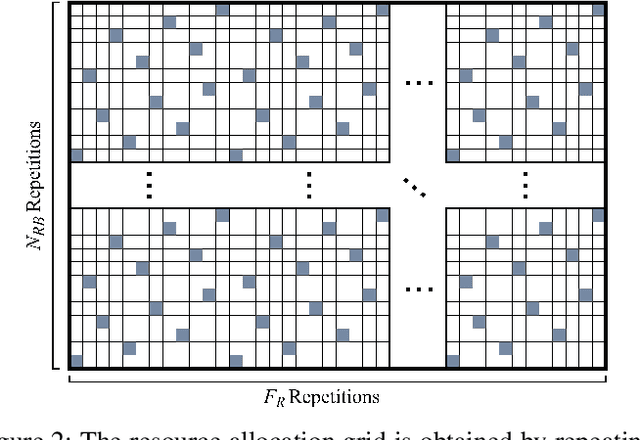
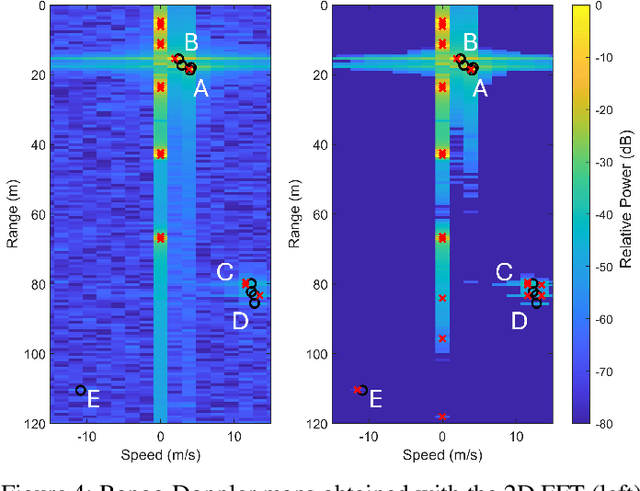
To enable widespread use of Integrated Sensing and Communication (ISAC) in future communication systems, an important requirement is the ease of integration. A possible way to achieve this is to use existing communication reference signals for sensing, such as the 5G Positioning Reference Signal (PRS). Existing works have demonstrated promising results by using the PRS with classical signal processing techniques. However, this approach suffers from a loss of SNR due to the sparse resource allocation. In this work, we improve upon existing results by combining the 5G PRS with compressed sensing methods. We demonstrate that our method achieves better noise robustness compared to the existing works and has superresolution properties, making it an ideal choice for range-Doppler map generation and target detection even in noisy environments.
I-SCOUT: Integrated Sensing and Communications to Uncover Moving Targets in NextG Networks
Oct 11, 2024Integrated Sensing and Communication (ISAC) represents a transformative approach within 5G and beyond, aiming to merge wireless communication and sensing functionalities into a unified network infrastructure. This integration offers enhanced spectrum efficiency, real-time situational awareness, cost and energy reductions, and improved operational performance. ISAC provides simultaneous communication and sensing capabilities, enhancing the ability to detect, track, and respond to spectrum dynamics and potential threats in complex environments. In this paper, we introduce I-SCOUT, an innovative ISAC solution designed to uncover moving targets in NextG networks. We specifically repurpose the Positioning Reference Signal (PRS) of the 5G waveform, exploiting its distinctive autocorrelation characteristics for environment sensing. The reflected signals from moving targets are processed to estimate both the range and velocity of these targets using the cross ambiguity function (CAF). We conduct an in-depth analysis of the tradeoff between sensing and communication functionalities, focusing on the allocation of PRSs for ISAC purposes. Our study reveals that the number of PRSs dedicated to ISAC has a significant impact on the system's performance, necessitating a careful balance to optimize both sensing accuracy and communication efficiency. Our results demonstrate that I-SCOUT effectively leverages ISAC to accurately determine the range and velocity of moving targets. Moreover, I-SCOUT is capable of distinguishing between multiple targets within a group, showcasing its potential for complex scenarios. These findings underscore the viability of ISAC in enhancing the capabilities of NextG networks, for both commercial and tactical applications where precision and reliability are critical.